What is a barometric loop and how does it work?
Why was it developed?
Why is it less used today?
Today, backflow protection relies primarily on mechanical devices such as vacuum breakers or backflow prevention devices (BPDs). However, before these technologies became widespread, some installations used a purely hydraulic solution: the barometric loop.
Rarely mentioned in modern guides, this technology relies on a surprisingly simple principle. It uses the height of a water column to physically block a water backflow, without any moving parts. No spring, no valve, no motor; just pipes and the laws of physics doing all the work.
Is it still relevant today?
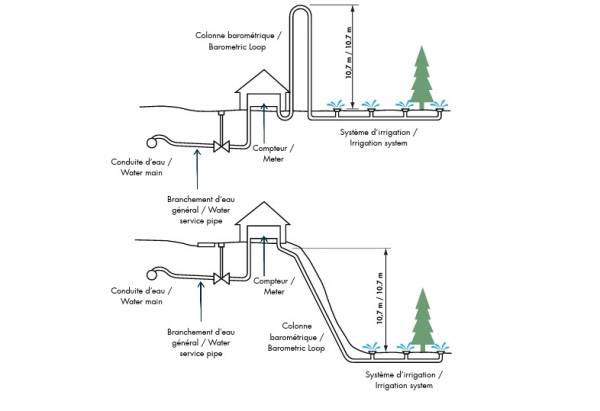
A barometric loop is a section of piping that rises or falls to a minimum of 35 feet (10.7 m) from the point of use [1]. Its function is to strictly prevent back-siphonage, which is a backflow of water caused by negative pressure in the system.
Figure 1: CSA B64.10 (DAr)\B64.10 - 2017
Even a perfect vacuum cannot support a column of water more than 33.9 feet (10.3 m) at sea level [1]. By creating a loop at least 35 feet high, we create an obstacle that siphonage cannot surmount. If a drop in pressure occurs upstream, the water cannot be pulled to the top of the loop, which prevents it from returning to the source of drinking water [5].
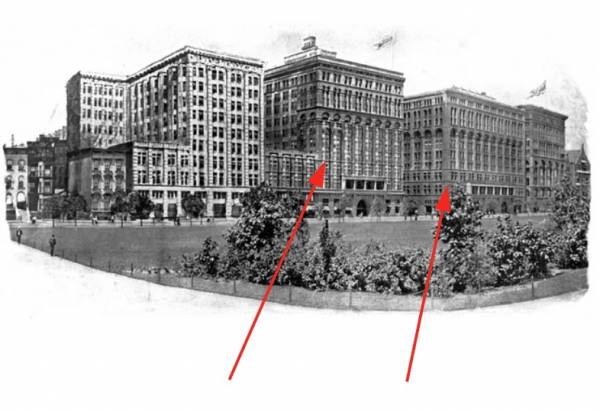
With the expansion of municipal water networks in the early 20th century, the potential for drinking water lines and non-potable sources to cross-contaminate increased significantly. Perhaps the most notable incident occurred in 1933. During the Chicago World's Fair, a faulty cross-connection contaminated the water supply shared by two hotels, which drew from a shared rooftop source, resulting in approximately 98 deaths and 2,000 cases of amoebic dysentery.
This incident led directly to the establishment of a research center focused on hydraulics and cross-connection control, as well as to an accelerated scientific study of backflow prevention [6].
For a long time, the barometric loop was an attractive solution for protection against back-siphonage. At a time when mechanical backflow prevention devices were not well-developed, it offered protection that did not require any special maintenance nor involve any mechanical components needing periodic inspection.
Figure 2: Congress Plaza Hôtel et l'Auditorium Hôtel
Despite its advantages, the barometric loop has been largely replaced by mechanical backflow prevention devices for several practical reasons.
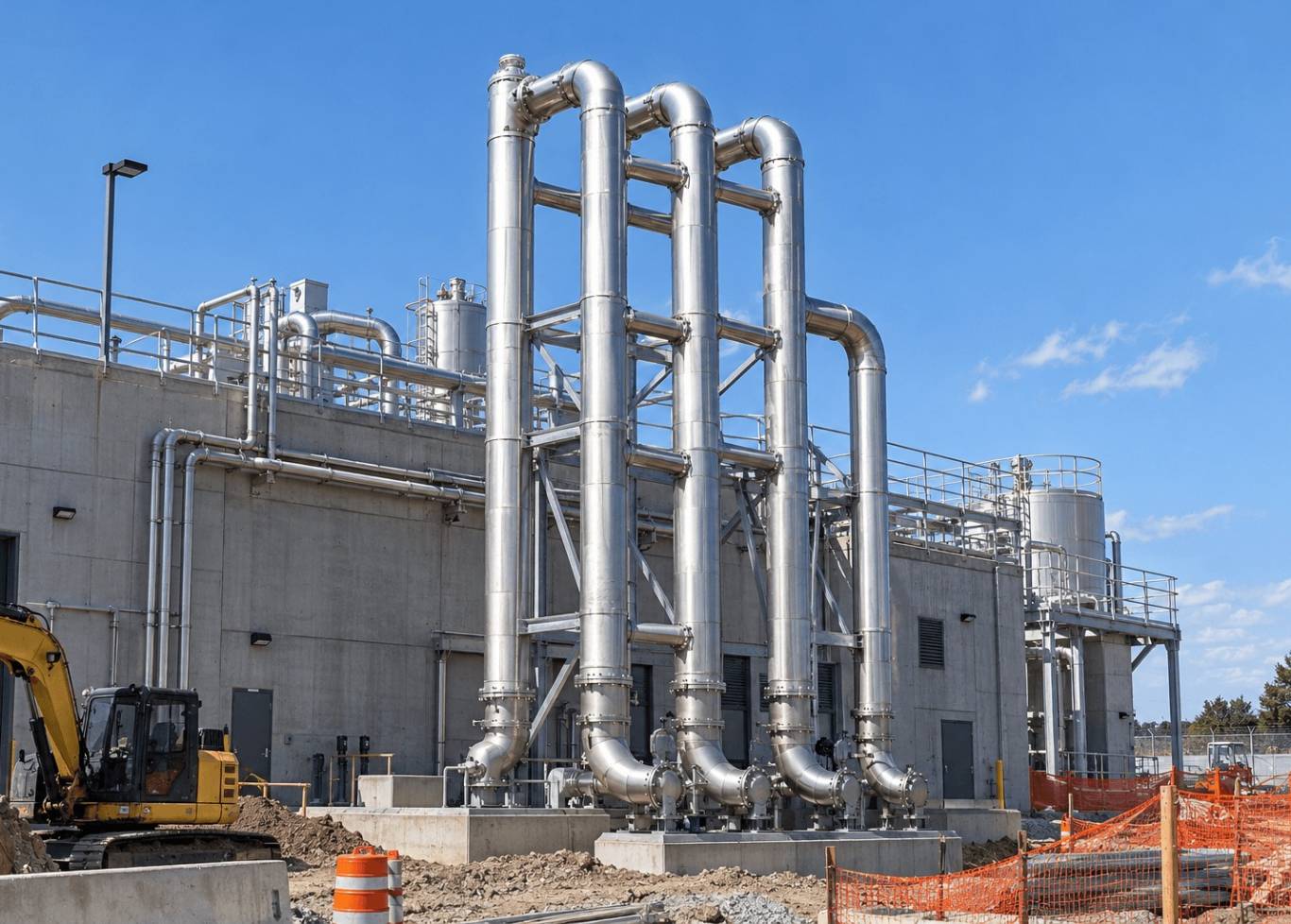
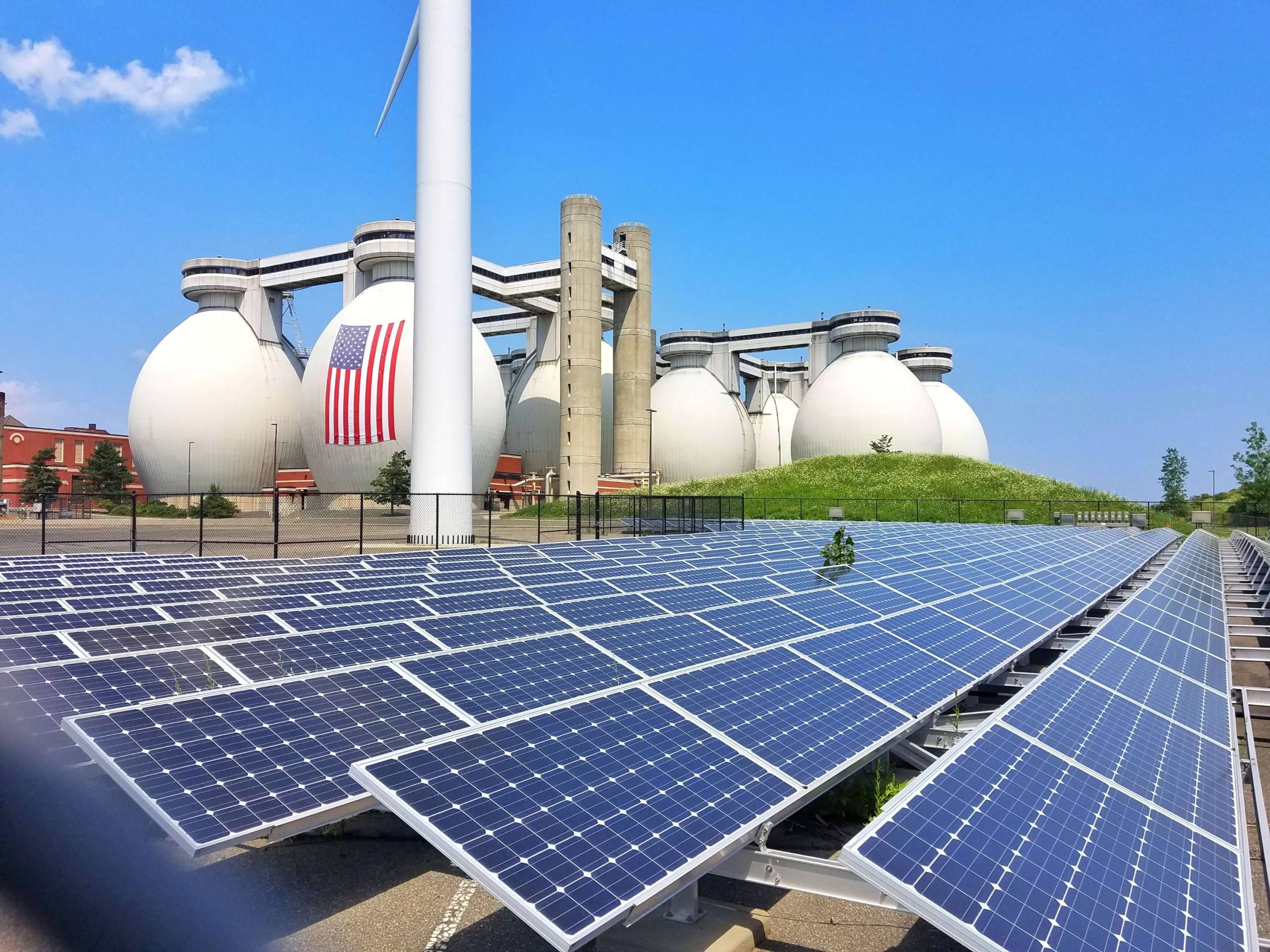
Figure 3: ‘Deer Island’ Wastewater Treatment Plant
In conclusion, despite these drawbacks, it still remains an attractive option in certain industrial settings where vertical space is not an issue, such as in water treatment plants.
[1] United States Environmental Protection Agency (EPA). Cross-Connection Control Manual, Chapitre 4 — Methods and Devices for the Prevention of Backflow and Back-Siphonage
[2] CSA Group. CSA B64.10-17/B64.10.1-17, Backflow Prevention Device Selection and Installation Manual. Toronto (ON): CSA Group, 2017.
[3] City of Calgary. Frequently Asked Questions — Cross-Connection Control Program.
[4] National Plumbing Code of Canada — provisions for barometric plumbing (CSA B64); U.S. Uniform/International Plumbing Code — similar definitions of barometric curb.
[5] Hunter, R.B., Golden, G.E. et Eaton, H.N. (1938). « Cross-Connections in Plumbing Systems ». Research Paper RP1086, Journal of Research of the National Bureau of Standards, vol. 20. nvlpubs.nist.gov
[6] American Society of Plumbing Engineers (ASPE). "National Backflow Prevention Day" — account of the 1933 Chicago cross-contamination incident.
Figure [1] CSA B64.10 (DAr)\B64.10 - 2017
Figure [2] https://commons.wikimedia.org/wiki/File:Auditorium_Hotels,_Chicago_c._1905.png
Figure [3] https://commons.wikimedia.org/wiki/File:Deer_Island_Waste_Water_Treatment_Plant_-_02.jpg
We use cookies
Respecting your privacy matters to us. We use cookies to personalize our content and facilitate your digital experience. Some cookies may be collected with your consent.
Essential
Essential cookies help make a website usable by enabling basic functions such as page navigation and access to secure areas of the website. The website cannot function properly without these cookies.
Performance
These cookies enable us to analyze navigation on our sites and improve their operation.
Customization
Preference cookies enable a website to remember information that modifies the behavior or appearance of the site, such as your preferred language or the region you are in.
Targeted advertising
These cookies help us limit the number of times you see an advertisement, personalize our offers and services according to your centers of interest, measure the effectiveness of an advertising campaign, and so on. They may be shared with our partners.
We use cookies
Respecting your privacy matters to us. We use cookies to personalize our content and facilitate your digital experience. Some cookies may be collected with your consent.